

Nameplates, Fonts and Patches: How Football Shirt Printing Works
Updated 16 September 2026 · by the Jersey Pro Center team
Quick answer
A nameplate is the panel a player's name sits on. In football the name is usually heat-pressed straight onto the shirt back, while NFL, NBA, MLB and NHL jerseys use a separate fabric plate. Because clubs play in more than one competition, the same shirt is printed two ways: domestic league matches use the league lettering set, continental cup matches use the competition's own set, often with sleeve patches. Printed names usually lose their accents, so Real Madrid print MBAPPE and Liverpool print SUAREZ. Numbers change too: Mbappé wears 10 at Real Madrid and 7 at PSG; Bellingham wears 5 at Real Madrid and 10 for England.
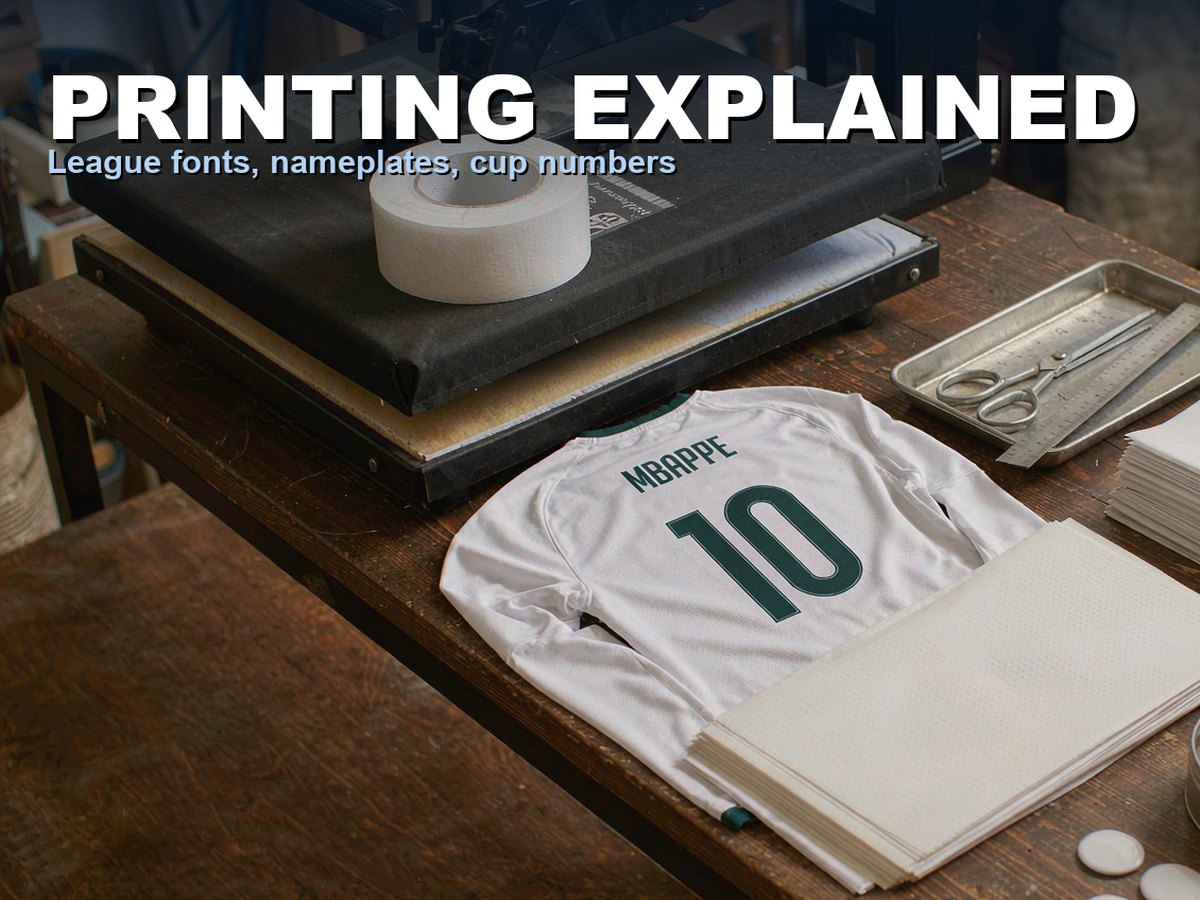
Two shirts, same club, same season, two different sets of letters on the back — and both correct. Here is how football shirt printing actually works, and how to read a printed nameplate before you buy.
What a nameplate actually is
Two different constructions share one word, and that is where most of the confusion starts.
- A nameplate is a separate strip of fabric with the name applied to it, which is then attached to the upper back of the jersey. This is the standard build in the NFL, NBA, MLB and NHL — run your hand across the back of an American football jersey and you can feel the plate edge.
- Football printing is normally applied directly to the shirt. Letters and numerals are cut from a printed film and heat-pressed onto the fabric, so the back of the shirt stays flat and there is no strip to feel.
So a football shirt with a printed name and no nameplate is completely normal. It is a different way of doing the same job, not a cheaper version of it.
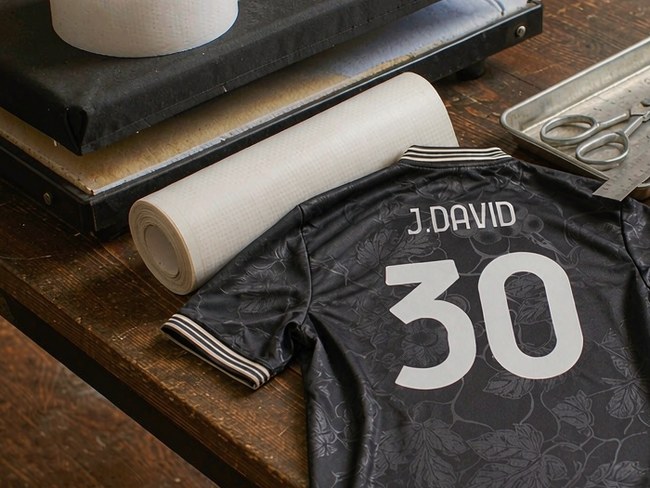
League font vs cup font: why one shirt gets printed two ways
A club plays domestic league matches and continental cup matches in the same shirt. Each of those competitions publishes its own lettering specification — letter shapes, weight, how the numerals are outlined, and how much of the back the name is allowed to cover. Match the shirt to the competition and the printing changes with it.
| Competition type | What the lettering looks like | What else changes |
|---|---|---|
| Domestic league Premier League, La Liga, Serie A, Bundesliga, Ligue 1 |
The league's own letter and numeral set, used across every club in that league | League badge on the sleeve; some kits add a league-specific pattern inside the numerals |
| Continental cup European club competitions |
The competition's own set — usually a different weight and outline from the league font | Cup badge on the sleeve, and in some seasons a second sleeve element |
| Domestic cup | Often the league font reused, or a plain block set | Fewer sleeve requirements than the other two |
| International | Set by the tournament or the national federation | Different sleeve treatment again; the shirt itself is a different product |
The practical consequence: two shirts of the same club, same season, can legitimately carry two different sets of letters. Neither is wrong. If you are matching a shirt to a specific match you remember, the lettering is part of what you are matching.
Accents, initials and apostrophes: what actually lands on the fabric
Printed name sets are cut from a fixed character set, and the first thing that disappears is the diacritic. You can see it in our own product photos:
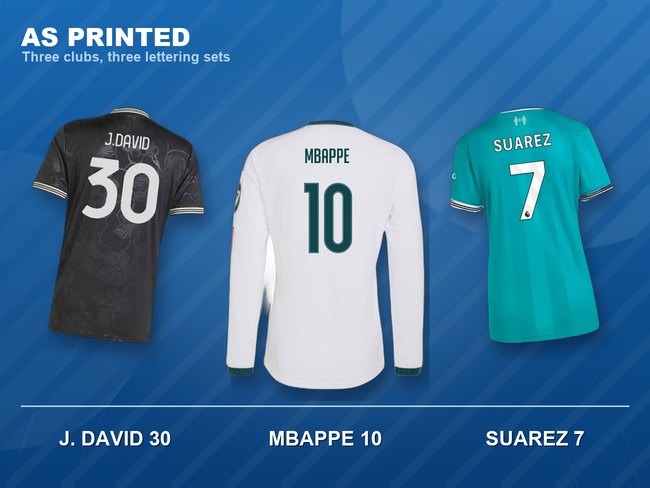
Three things follow from that. Accents are dropped, so the same player can appear with and without one depending on which set was used. Initials get added where a surname is short or shared, which is why you will see J. DAVID rather than DAVID on some shirts. And long surnames are set in a narrower version of the same font rather than a smaller one, so the name stays the same height as every other name on the pitch.
Sleeve patches: the other half of the story
Printing is not only the back. Sleeve patches identify the competition, and they are the part people forget when they are matching a shirt to a season. A league shirt carries the league badge; a cup shirt carries the cup badge, sometimes with a second element on the other sleeve.
Patches usually arrive with the shirt rather than being an add-on, which is why the patch set is worth checking in the product title and photos before you buy. One example from our own shelves: our Chelsea 2026/27 home match shirt is listed with its patch set — and note that this particular one is the close-fitting authentic match cut, not the supporter cut, which the product title makes clear.
Chelsea 2026/27 home match authentic patch jersey All football shirts
The number is not fixed either: Mbappé and Bellingham
A player's number is registered per competition, not per person. That is why the same name comes with a different numeral depending on which shirt you are holding — and both can be correct at the same time.
Mbappé wears 10 in the Real Madrid shirts we stock, and 7 in the PSG shirts we stock, including the 1993 home shirt and the 2019-20 home shirt. Bellingham wears 5 at Real Madrid and 10 on the England shirts. Same player, two numbers, two different printing jobs — and if you are buying a shirt from a specific season, the number on the product photo is the number you get.
Mbappé shirts — 10 and 7 Bellingham shirts — 5 and 10 Real Madrid shirts PSG shirts
Two more places numbers come from
A number can also change for a simpler reason: a new signing takes the shirt, or a player moves club and inherits a different squad number. That is why our Liverpool shirts are printed Wirtz 7 and Szoboszlai 8, our Juventus third shirt is printed J. David 30, and the Arsenal shirts in stock carry Williamson 6 and Trossard 19. None of those numbers are guessable — they are printed on the shirt in front of you.
Liverpool shirts Juventus shirts
What to check before you buy a printed shirt
- Read the lettering in the photos. That is the print that ships. If the photo shows MBAPPE 10, the shirt arrives printed MBAPPE 10.
- Decide which competition's font you want. League font and cup font are different looks on the same shirt.
- Check the number for that club and that season. Club number and country number are often not the same.
- Check whether the shirt is listed with a patch set, and which sleeve it sits on.
- Check the size before the printing. A printed shirt is the same size as its unprinted twin — the print adds nothing to the fit, so pick the size you would pick anyway.
How the print arrives. The letters and numerals in the product photos are the ones that ship: the name is part of the product you are buying, and a standard football shirt page has no step where a different name is entered. If a shirt is listed without a name set, it arrives without one. The shirts titled Custom are the exception: those are built around a name rather than a fixed player's shirt, and we stock them in the NCAA college range and across several NFL teams — the Kansas City Chiefs and Philadelphia Eagles game jerseys among them. Everything else in the shop, at every cut, ships with the name and number shown on its product page. On cut: most of our football shirts are the supporter (fan) cut, and where a shirt is listed as Authentic or on-field it is the close-fitting match cut instead — the product title always tells you which.
Where to go next
If you are matching a shirt to a player rather than a club, start from the player collections — they gather every shirt we hold for that name, across clubs, seasons and competitions. If you are matching it to a competition instead, the club collections carry the league, cup and patch versions side by side.
Ready for matchday? Use code SUBSCRIBE10 at checkout for 10% off your first order — free shipping over $57, flat $7 below that, and 30-day free returns if the fit is not right.
Browse all football shirts Shop by player Size guide FAQ & shipping
Related guides
These three go deeper on the decisions that sit either side of printing:
- European club shirts: the 2026-27 buying guide — what is actually in stock, club by club.
- Fan edition vs authentic cut vs training vs retro — the four shirt types and the sizing trap on authentic cuts.
- Jersey sizing compared across six sports — which jerseys run large, which run small.
Related guides
- England vs Spain 2026 - how the 2026-27 England and Spain shirts are printed, name by name.
Common questions
Why do some football shirts have different lettering fonts?
Because each competition publishes its own lettering set. Domestic league matches use the league font — the same letters and numerals across every club in that league — while continental cup matches use the competition's own set, which usually has a different weight and outline. The same shirt, in the same season, is therefore printed two different ways.
What is a nameplate on a jersey?
The panel a player's name is applied to. In the NFL, NBA, MLB and NHL it is a separate strip of fabric attached to the upper back, so you can feel the edge. Football shirts normally skip the plate and heat-press the name set straight onto the shirt, which leaves the back flat.
Why are names printed without accents?
Name sets are cut from a fixed character range and the diacritic is usually dropped. In our own product photos the Real Madrid long-sleeve home shirt is printed MBAPPE and the Liverpool third shirt is printed SUAREZ. You will see the same player printed with and without an accent depending on which set was used.
Why does the same player have a different number for club and country?
Squad numbers are registered per club and per competition, and they change when a player moves. Mbappé wears 10 in the Real Madrid shirts we stock and 7 in the PSG shirts we stock. Bellingham wears 5 at Real Madrid and 10 on the England shirts. The number on the product photo is the number you receive.
What are the patches on the sleeves of a football shirt?
Competition badges. A league shirt carries the league badge, a cup shirt carries the cup badge, and some seasons add a second element on the other sleeve. Patches normally come with the shirt — our 2026-27 Chelsea home match shirt is listed with its patch set.
Do your shirts arrive with the printing already applied?
Yes, where the product page shows a name and number. The print shown in the photos is the print that ships, and there is no step on a standard football shirt page where a different name is entered. Shirts listed without a name set arrive without one. The shirts titled Custom are the one exception — we list them in the NCAA college range and in several NFL team game jerseys, and they are built around a name rather than a fixed player's shirt. Cut is a separate question: supporter cut as standard, close-fitting Authentic where the title says so.
Jersey Pro Center ships football shirts, basketball and baseball jerseys, NHL and NCAA kits to the US, Canada, UK, EU and Australia. Supporter (fan) cut as standard · close-fitting Authentic or on-field cut where the product title says so. Free shipping over $57 · 30-day returns · Use code SUBSCRIBE10 for 10% off your first order.